

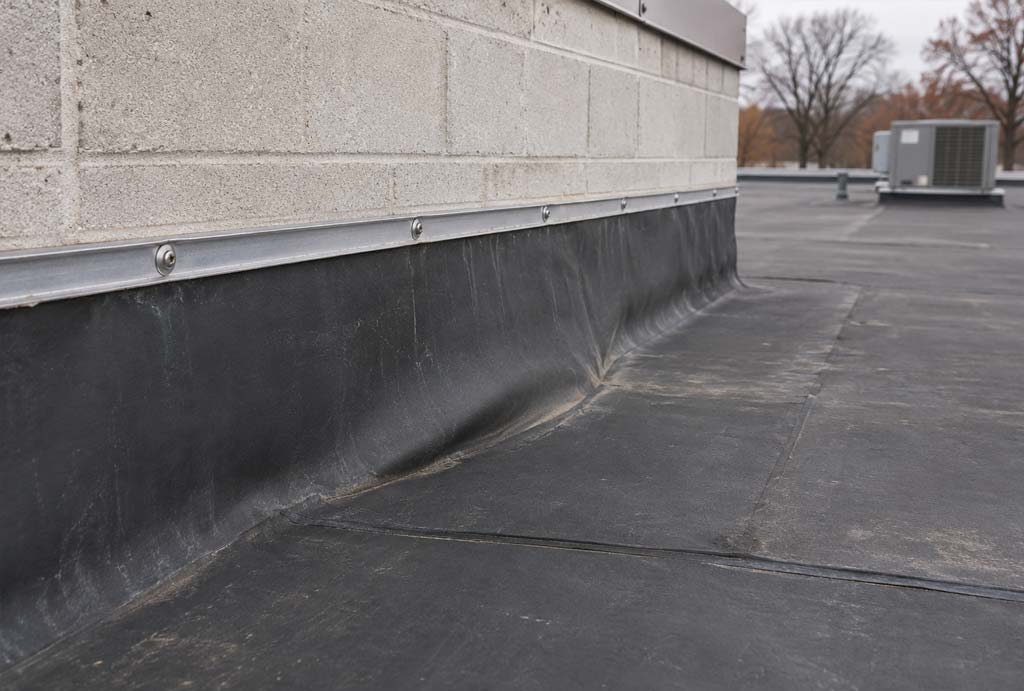
An EPDM rubber roof may pull away from an edge or wall because of membrane tension, failed adhesion, inadequate attachment, or movement in the supporting assembly. Shrinkage can contribute in some cases, but a lifted corner does not establish the cause by itself.
The visible change may look like rubber stretched across a corner instead of resting against it. Roofers often call this bridging or tenting.
At Stay Dry Roofing, we investigate why the membrane has moved before proposing a patch. For Indianapolis building owners, the important question is whether the repair will restore a stable connection or simply cover an area that remains under stress.
What Does Pulling Away Look Like?
On a low-slope roof, the membrane may turn upward at a parapet wall, equipment curb, or other raised detail. Trouble can appear where that direction changes or where the membrane terminates.
A stressed area may form a taut diagonal across the inside angle. Elsewhere, wall flashing may detach, a corner may stretch, or the upper attachment may become loose.
These conditions are different from a minor surface ripple. The location, attachment method, and effect on nearby seams determine whether the condition needs repair.
EPDM is a synthetic rubber roofing material, commonly black. Other membranes can look similar after weathering. Our comparison of TPO, EPDM, and PVC roofing explains the differences, but installation records or a professional assessment should confirm the system before repair products are selected.
Is the Rubber Shrinking?
Possibly, but that should not be the automatic diagnosis.
The EPDM Roofing Association’s explanation of dimensional stability discusses shrinkage as a possible contributor to bridging in some older ballasted installations. It also notes that EPDM has historically demonstrated strong dimensional stability.
That distinction matters. A roof can develop perimeter tension because the overall assembly is not managing movement properly, even when the membrane itself remains serviceable.
An inspection should consider the system’s age, installation method, previous alterations, and whether the condition is confined to one detail or repeated around the building. Calling everything “rubber shrinkage” can overlook an attachment failure that needs a different repair.
Three Connections That Need Attention
The bond beneath the membrane
Where the design relies on adhesion, the membrane needs an appropriate bond to a suitable surface. A failed bond can allow the material to lift away from the wall or underlying roof component.
Poor surface preparation, unsuitable materials, deterioration, or application problems may be involved. Simply adding adhesive to the exposed edge may leave the original cause unresolved.
The attachment at the change in direction
Many EPDM details require additional securement where the roof meets a wall or curb. That connection helps manage forces acting on the membrane.
If required securement is absent, loose, or attached to deteriorated material, stress can transfer to flashings and nearby seams. Correcting the attachment may be as important as replacing the visibly stretched rubber.
The termination higher on the wall
The upper edge of wall flashing also needs a suitable termination. A loose bar, failed connection, or damaged substrate can leave an opening behind the membrane.
Carlisle’s commercial roof inspection guidance highlights perimeter securement, terminations, and flashing details as inspection priorities. The appropriate configuration depends on the specific roof system.
Can the Edge Be Repaired Without Replacing the Roof?
Often, a localized repair is possible when the surrounding membrane and supporting materials are sound.
Depending on the findings, work may involve relieving a stressed section, rebuilding its attachment, replacing affected flashing, and joining new compatible material to the existing roof. This is professional repair work, not a recommendation to cut or stretch the membrane yourself.
A useful proposal should describe how tension will be addressed and how the repaired area will connect to stable materials. A patch over a stressed corner may fail again if the forces pulling on it remain.
Before closing the area, the roofer should also assess suspected moisture damage. Our guide to wet insulation in commercial roofs explains why repairing the visible opening may be only part of the work.
When Does the Problem Need a Broader Plan?
A larger scope may be justified when the same defect appears along multiple edges, supporting materials have deteriorated, or repeated repairs have failed.
The roof’s overall condition matters. Widespread membrane damage, extensive moisture, and unreliable attachment can change the value of another isolated repair.
A building owner should be able to understand what is local and what is systemic. Ask for photographs showing the affected locations and an explanation of which findings support repair, partial replacement, or full replacement.
Our commercial roofing services include evaluating the existing assembly so recommendations reflect the building’s condition.
What Should Owners Do Before Winter?
If you notice a new separation or a visibly stressed corner, arrange an assessment rather than waiting for an interior leak. Do not pull the membrane back into place, add improvised fasteners, or apply a general-purpose coating.
In late November, dry surfaces, material temperatures, and safe roof access can affect the repair schedule. Cold weather alone does not establish that the membrane has failed, but suitable application conditions still matter.
Stay Dry Roofing serves Indianapolis and surrounding Central Indiana communities. Request an evaluation to find out what is moving and whether a targeted repair can restore the connection.
Frequently Asked Questions
Does tenting mean water is already entering the building?
Not necessarily. A stressed membrane can remain watertight while placing additional strain on seams and flashings. Inspection can identify whether openings or moisture are present.
Can all EPDM wrinkles be treated as shrinkage?
No. Wrinkles may relate to installation, attachment, or other conditions. A wrinkle across an open roof area and a taut membrane bridging a wall corner require different evaluation.
Can roofing cement hold the rubber back in place?
General-purpose roofing cement is not a substitute for proper EPDM attachment and compatible repair materials. Some products can damage the membrane. Follow the roof manufacturer’s requirements.
Can older EPDM accept a new repair patch?
Often, yes, if the existing material remains suitable and is prepared correctly. Surface condition, contamination, compatibility, and the manufacturer’s repair procedures determine the approach.
Should the roofer check more than the visibly lifted corner?
Yes. Similar corners, adjacent seams, wall attachments, and other perimeter sections should be examined to determine whether the condition is isolated or part of a wider pattern.