

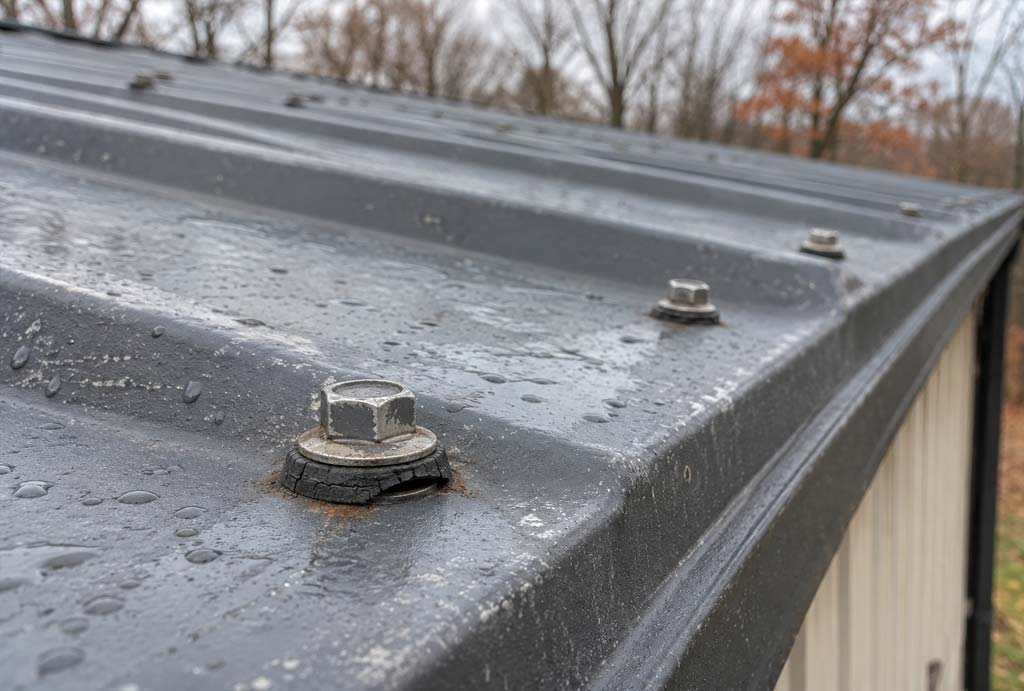
Metal roof screws can leak when their sealing washers deteriorate, the fasteners lose their grip, or installation problems leave an opening around the screw. The metal panels may still be serviceable even though the connection is no longer watertight.
For an Indianapolis homeowner or building owner, that raises a practical question: Does the roof need a few replacement screws, a broader fastener repair, or something more?
At Stay Dry Roofing, we start by identifying the roof system and the actual source of water. Replacing screws without understanding why they failed can leave you chasing the same leak.
Which Metal Roofs Have Exposed Screws?
Exposed-fastener roofs have visible screw heads arranged across the panels. Each screw passes through the metal and secures it to the decking or framing below. A sealing washer beneath the head helps protect that penetration.
These systems appear on homes, garages, workshops, agricultural buildings, and commercial properties. Their fasteners need to remain secure while maintaining a weather-resistant seal.
Most standing seam metal roofing systems conceal their main attachment points beneath raised seams. They may still have exposed fasteners at certain trim details, but their inspection and repair needs differ.
Knowing which system you have prevents applying the wrong repair method.
Why Can a Metal Roof Screw Start Leaking?
The sealing washer has deteriorated
The washer is a small component with an important job. Weather exposure and age can leave it cracked, hardened, split, or unable to seal properly against the panel.
A screw can look firmly attached while the washer beneath it has failed. Turning that screw farther does not restore damaged rubber.
The screw was installed incorrectly
A fastener driven too loosely may leave a gap beneath the washer. One driven too tightly can distort the washer or damage the surrounding panel. A screw installed at an angle may apply uneven pressure.
Fastener manufacturer SFS explains how incorrect screw installation can cause metal roof leaks, including problems caused by overdriving and poor alignment.
The fastener has lost its holding strength
A screw needs sound material below the panel to stay secure. Stripped threads, deteriorated wood, or an unsuitable connection can prevent it from holding.
Repeatedly tightening a screw that no longer grips does little to solve the problem. The condition of the attachment point must be evaluated.
Movement has stressed the connection
Metal expands and contracts as its temperature changes. Wind also places loads on the panels. The roof’s design and fastening pattern must accommodate those forces.
Movement can expose weaknesses in an aging or improperly installed connection. It does not mean every seasonal temperature change will loosen a correctly installed screw.
How Do You Know Whether the Screws Are the Problem?
A visible gap, deteriorated washer, missing fastener, or rust around a screw deserves attention. However, appearance alone cannot establish where a leak begins.
During an inspection, we may also need to evaluate panel overlaps, roof transitions, pipe flashings, and previous patches. Water entering at one detail can travel before becoming visible inside.
For example, a stain near a row of screws could originate at flashing farther upslope. Condensation beneath metal can also resemble water intrusion and requires a different solution.
Our metal roof repair services focus on identifying the failed component before choosing a repair. Photographs of the affected area and notes about when dripping occurs can help guide that investigation.
When Is Limited Screw Replacement Enough?
A localized repair may be reasonable when the issue affects a small area, adjacent connections remain sound, and the panels and underlying support are in good condition.
The replacement must suit the roof. Thread design, diameter, length, corrosion resistance, washer assembly, and the material being fastened all matter.
McElroy Metal’s guidance on exposed-fastener roof installation emphasizes following the panel manufacturer’s fastening requirements. The same attention to system compatibility matters during repairs.
Some existing holes require an approved repair fastener. Others need additional work because the hole, panel, or supporting material is damaged. Simply selecting a longer screw is not a universal fix.
When Should More of the Fasteners Be Replaced?
Broader replacement may make sense when deteriorated washers or loose connections occur across several roof sections, rather than at one isolated point.
A useful proposal should explain the pattern of failure, the areas included, the replacement fastener specification, and how damaged attachment points will be handled.
There is no single replacement deadline that applies to every metal roof. Fastener quality, installation, exposure, maintenance, and the roof’s condition affect the decision.
Widespread fastener problems also do not automatically require new panels. However, extensive corrosion, torn holes, failing supports, or multiple unresolved details may make screw replacement alone inadequate.
Will Sealant Over the Screw Heads Stop the Leak?
A compatible sealant can be part of a specified repair detail. A surface coating over a failed screw, however, does not restore its grip or replace a deteriorated washer.
A roof covered in repeated patches may also be harder to diagnose because the original connections are concealed. Before adding another layer, determine what the previous repair was intended to address and why it failed.
If a contractor recommends sealing every screw, ask how the work addresses loose fasteners, damaged holes, and material compatibility.
Have Suspect Connections Checked Before Winter
November is a practical time to investigate an exposed-fastener roof with recurring drips or visible deterioration. Rain, frost, and shorter workdays can affect access and scheduling as winter approaches.
Do not climb onto wet or frosted metal to tighten screws yourself. Roof access and repairs require suitable equipment, conditions, and fall protection.
Stay Dry Roofing serves Indianapolis and surrounding communities, including Carmel, Fishers, and Noblesville. Request a roof evaluation so we can explain whether targeted repairs or a broader scope fits your roof.
Frequently Asked Questions
Should every screw be replaced when one starts leaking?
No. One failed connection calls for inspecting nearby fasteners and the broader roof. The extent of deterioration determines whether replacement should remain localized or cover additional areas.
Is a screw that spins without tightening a problem?
It can indicate that the fastener is not engaging the material beneath it. Continuing to drive it may worsen the connection. A roofer should determine whether the hole or underlying support needs repair.
Can you replace only the rubber washer?
That depends on the fastener assembly and manufacturer’s requirements. Replacing the complete fastener and sealing assembly may be appropriate, especially if corrosion, poor engagement, or damage is also present.
Does rust around a screw prove that it is leaking?
No. Rust is a reason to investigate, but it does not establish an active leak. Inspection should assess the fastener, washer, panel coating, and evidence of moisture below.
Can new screws stop leaks without replacing the metal roof?
Sometimes. Correctly specified fastener repairs can address connection failures on otherwise serviceable panels. They will not resolve unrelated flashing defects, extensive panel deterioration, or condensation.