

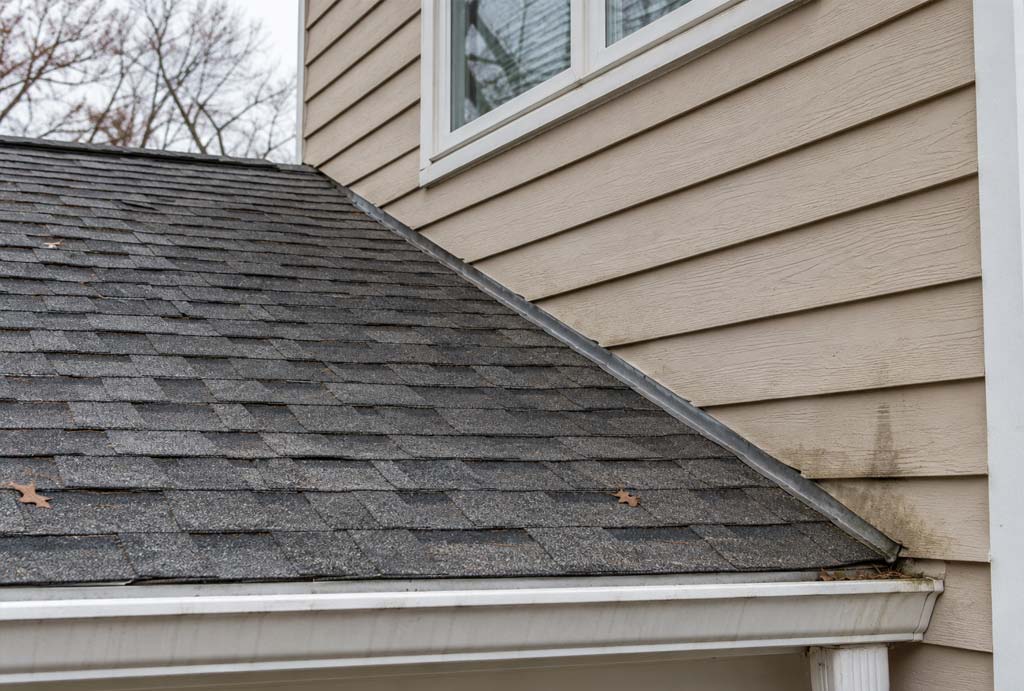
A leak where a roof meets siding can come from damaged or poorly connected flashing, missing water-diverting details, or defects in the wall above. The shingles and siding may each look serviceable while the connection between them allows water inside.
This often affects a garage roof beside a taller house wall, a dormer, or a porch attached to the main building. Rain follows the roof toward that intersection, making small installation details important.
At Stay Dry Roofing, we examine how those materials overlap and drain. The goal is to identify the path water takes before deciding which components need repair.
Two Different Roof-to-Wall Connections
The shape of the intersection helps determine the flashing it needs.
A sidewall runs beside a sloping roof. On an asphalt-shingle roof, individual pieces of step flashing are typically woven into the shingle courses along that wall.
A headwall crosses the upper end of a roof slope. It requires a different flashing arrangement that directs water from the wall onto the roof below.
Confusing those details can lead to an incomplete repair. A visible metal strip is not enough to establish that the assembly is installed correctly. The concealed connections matter, too.
How Step Flashing Keeps Runoff Outside
Step flashing consists of overlapping metal pieces. Each piece turns up the wall and extends beneath the shingles, allowing water to move down the roof without entering the joint.
Its wall-side protection must connect with the drainage layer behind the siding. Otherwise, water traveling behind the siding may run behind the flashing instead of onto the roof.
The Department of Energy’s guide to flashing roof-wall intersections in existing homes explains why repairs may require removing siding and integrating the roof and wall protection.
That is one reason a flashing problem cannot always be corrected from the exposed roof surface alone.
What Kickout Flashing Does at the Bottom
At the lower end of a sidewall, runoff needs to leave the wall and enter the gutter. Kickout flashing is the diverter that makes that turn.
When it is missing, too small, or improperly connected, water can flow against the siding near the gutter end. Over time, this may wet the materials behind the exterior finish.
The Building America Solution Center’s guidance on step and kickout flashing describes how these components work together to protect the wall and redirect runoff.
This is a specific roof-to-wall concern. Water appearing along a longer stretch of fascia may have another cause, as our article on water behind gutters explains.
Why the Junction Can Fail After Roofing or Siding Work
A leak that appears after a project does not automatically establish who caused it. However, the work history helps identify what should be inspected.
During reroofing, existing flashing may be damaged, covered, or left disconnected from the new roofing. During siding replacement, wall protection may be cut or installed so it directs moisture behind the flashing.
Siding installed too close to the roof surface can also complicate drainage, drying, and access. The required clearance depends on the siding product and its installation instructions.
Ask whether both trades reviewed the shared connection. A new roof and new siding still need a properly integrated transition between them.
Signs That Deserve a Closer Look
A stain beside the end of a lower roof, peeling finishes near the intersection, or recurring dampness in the adjoining room may justify investigation.
You might also notice a heavy sealant patch along the wall or siding that appears swollen, loose, or deteriorated. These are clues rather than proof of the entry point.
Pay attention to conditions above the junction. A window, trim joint, wall penetration, or another roof section may admit water that travels behind the siding.
From a safe location, photograph the affected area and record when it becomes wet. Avoid lifting siding or shingles yourself. A professional roof inspection can connect those observations with the exterior details.
What a Lasting Repair May Involve
A useful repair plan identifies which connection failed and how it will be rebuilt.
Work may include temporarily removing nearby shingles and siding, replacing damaged flashing, restoring the wall’s water-resistant layer, and installing a suitable kickout diverter. If concealed wood has deteriorated, that damage needs attention before the assembly is closed.
Not every leak requires all those steps. A localized defect may have a smaller scope. The important point is that the repair must connect to sound materials around it.
Our roof repair services address the failed detail rather than relying on repeated surface patches. Ask for photographs showing the connection before it is covered.
Should the Gap Between the Roof and Siding Be Caulked?
A blanket bead of caulk along the entire junction can conceal a defect or interfere with intended drainage. It cannot replace missing step flashing or correct an incorrectly layered wall assembly.
Sealants do have legitimate uses in specified details. Their location, compatibility, and application should follow the roofing and siding requirements.
Before accepting a caulk-only repair, ask where water is entering and why sealant is the appropriate solution there.
Have the Connection Evaluated Before Winter
November rain can reveal a roof-to-wall leak before snow makes the area harder to inspect. An active leak should be assessed promptly, even if permanent work needs a suitable weather window.
Stay Dry Roofing helps homeowners in Indianapolis, Carmel, Fishers, Noblesville, and surrounding communities understand their repair options. If water keeps returning near a roof and siding junction, request an evaluation so we can investigate the connection.
Frequently Asked Questions
Can siding hide water damage near a roof intersection?
Yes. Exterior siding can look relatively intact while moisture affects the sheathing or framing behind it. Confirming the condition may require a limited opening after an initial inspection.
Does every roof-to-wall leak require new siding?
No. Some repairs allow existing siding to be carefully removed and reinstalled. Replacement may be necessary where materials are damaged, unsuitable for reuse, or unavailable in a compatible form.
Should step flashing be visible above the shingles?
A small reveal may be visible below the siding, depending on the assembly. Visibility alone does not prove a defect. The flashing’s height, overlap, condition, and connection behind the siding determine its performance.
Can gutter cleaning fix missing kickout flashing?
No. Cleaning restores gutter capacity but does not add the detail that directs water away from the wall. Both drainage and flashing should be checked if water repeatedly wets that corner.
Can a roofer repair wall flashing without replacing the whole roof?
Often, yes. A localized repair may be possible when nearby shingles, siding, and underlying materials can be worked on successfully. The inspection should establish how far the repair needs to extend.