

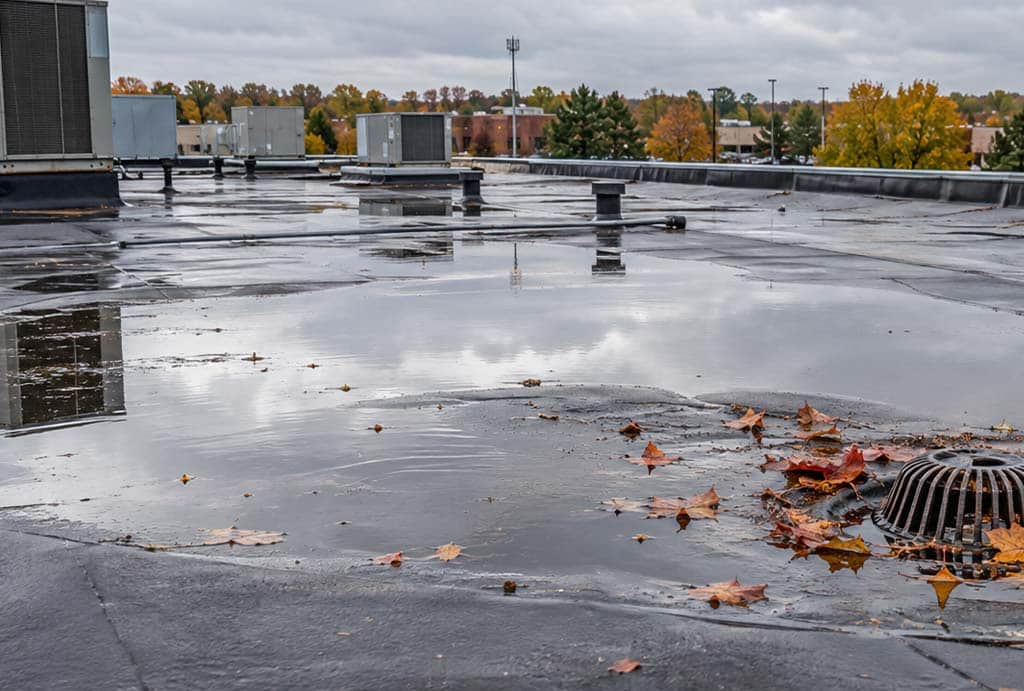
After an October rain, a property manager notices water still sitting on the roof beside an internal drain. The first thought is often that leaves have blocked the strainer. That may be true, especially as debris begins collecting in fall. But if the same pool appears after every storm, clearing leaves may not solve the underlying problem.
Water that remains on a commercial roof can point to a blocked drain, an obstructed scupper or downspout, a low spot, or a drainage layout that no longer moves water effectively. The useful question is not simply “How do we remove this puddle?” It is “Why does water collect here, and does it happen again once the outlet is clear?”
First, distinguish wet roofing from ponding
A low-slope roof may look damp for a while after rain. Small amounts of water can also dry as conditions improve. The National Roofing Contractors Association defines ponding as excessive water in a low area that remains more than 48 hours after precipitation under conditions conducive to drying. That definition is a useful benchmark, not a reason to wait two days if water is entering the building or a large amount is accumulating. See NRCA’s roofing glossary.
From a safe location, note when the rain stopped, roughly where the water sits, and whether it is getting smaller. Photographs taken at the same location after different storms are more useful than a single close-up of a puddle. Do not send untrained staff onto a wet roof to investigate. If there is an interior leak, unusually deep water, or an apparent drainage failure, arrange professional attention promptly.
Clues that the outlet is the problem
Leaves, gravel, packaging, or other debris can gather around a drain dome or scupper opening. A blocked internal drain may leave a broad pool centered on that outlet. Water may also back up when the roof opening looks clear but the connected pipe or downspout is obstructed farther along. A maintenance visit should check the drainage path, not just brush leaves away from the top.
GAF notes that low-slope commercial roofs rely on drainage paths to guide water off the surface and that debris commonly collects at drains because they sit at low points. Read GAF’s commercial drain-maintenance guidance.
If water clears after the outlet is serviced and does not return in the same place, the immediate problem may have been routine debris buildup. Record what was found and set a maintenance interval that reflects nearby trees, wind exposure, and rooftop activity. October is a useful time to establish that routine before more leaves arrive.
Clues that clearing the drain is not enough
Watch for a pool that forms several feet away from a clear outlet, leaves a persistent dirt ring, or reappears in the same depression after each rain. A section of roof may have settled or deflected. Drain locations or the slope built into the roof assembly may not direct runoff effectively. Previous repairs, added rooftop equipment, or changes around a drain can also affect how water moves.
That does not mean every puddle calls for a new roof. A roofer needs to assess the membrane, the drain details, the roof assembly, and the pattern of water movement before recommending repairs. Depending on the findings, the solution might involve correcting a drain connection, repairing a localized area, or planning a broader drainage improvement. If structural deflection or drainage design is suspected, the roofing contractor may need to coordinate with a qualified design or structural professional.
Avoid treating a coating as an automatic answer. Covering the surface does not make a low spot disappear, and it will not remove moisture already trapped beneath a membrane. Our article on wet commercial roof insulation explains when additional testing may be needed before a repair or restoration decision.
What to document before the inspection
You can help the contractor get to a useful answer without walking the roof yourself. Gather:
- The dates of recent rain and how long the water appeared to remain.
- Photos showing the whole roof area, the nearest drain or scupper, and the same location after more than one storm, if safely available.
- The roof plan or a simple marked drawing identifying the affected section.
- Interior leak locations, ceiling stains, and any affected inventory or equipment.
- Past drain cleanings, roof repairs, warranty documents, and recent HVAC or other rooftop work.
Ask the roofer to separate what can be seen from what needs further investigation. A written finding should identify whether the outlet was obstructed, whether water remains after it is cleared, and what work is recommended now versus what should be planned. That makes the result more useful for owners, tenants, and budget approval. Our commercial roof inspection report guide shows what a useful record should contain.
Address the cause before the next storm
For an Indianapolis commercial building, the lowest-cost answer may be a cleared drain and a dependable maintenance schedule. The more expensive mistake is assuming that cleaning fixed a recurring low spot without checking the roof after the next rain.
Stay Dry Roofing can inspect the affected area, document visible drainage conditions, and recommend the next appropriate step for the roof. Contact us about a commercial roof assessment if water is lingering, returning to the same spot, or appearing inside the building.
Frequently asked questions
Is standing water on a flat roof always a problem?
Not every wet area is ponding. Watch how the water changes after rain. Excessive water that remains beyond 48 hours during drying conditions, recurring pools, and any associated leaks deserve professional evaluation.
Can a clogged roof drain cause an interior leak?
It can contribute to a leak by allowing water to accumulate around vulnerable details, although the entry point may be elsewhere. The roof and drainage path need to be inspected before assigning a cause.
Will cleaning the drain fix a recurring puddle?
Only if the obstruction was the cause. If water still collects in the same low spot after the outlet is clear, the roof slope, assembly, or drain detail may need further assessment.
Should we install a roof coating over an area with ponding water?
Do not choose a coating solely to hide the symptom. First determine why water remains, whether moisture is trapped below the surface, and what the specific coating system and warranty allow.