


An aging commercial roof does not always need to be torn off and replaced. In some cases, a professionally installed roof coating can restore the existing system, improve weather protection, and extend its useful life. In other cases, coating an old roof only delays a replacement that the building already needs.
The right choice depends on more than the roof’s age. Building owners, facility managers, property managers, and association boards should consider the condition of the membrane, the amount of trapped moisture, drainage performance, previous repairs, insulation, and long-term plans for the property.
At Stay Dry Roofing, we help Indianapolis and Central Indiana property owners evaluate these factors before recommending a solution. Our goal is to give you a clear understanding of the roof’s condition and the available options—not push a coating onto a roof that should be replaced.
What Is a Commercial Roof Coating?
A commercial roof coating is a fluid-applied roofing product installed over an existing roof. Once cured, the coating creates a protective layer across the roof surface. Depending on the existing system and building conditions, coatings may be used over certain TPO, EPDM, modified bitumen, built-up, metal, and other low-slope roofs.
A coating is not simply roof paint. Successful installation requires proper preparation, repairs, cleaning, compatible materials, reinforced details, and the correct application thickness. Seams, penetrations, flashing, drains, curbs, and damaged areas may need to be repaired before the coating is applied.
Owners comparing different materials can review our guide to commercial roofing systems in Indianapolis.
When Is a Roof Coating a Good Option?
A coating may be appropriate when the existing roof is aging but remains in reasonably stable condition. The roof must have a suitable surface, adequate adhesion, and limited moisture beneath the membrane.
A commercial roof may be a candidate for coating when:
- The majority of the existing membrane remains secure.
- Leaks are limited to repairable seams, flashing, or penetrations.
- The insulation is mostly dry and still performing as intended.
- The roof deck does not have widespread deterioration.
- Drainage is functioning or can be corrected without major reconstruction.
- Surface wear is more serious than the damage beneath the membrane.
- The proposed coating is compatible with the existing roofing material.
- The owner wants to extend the roof’s service life before a future replacement.
Coating can also reduce the amount of material sent to a landfill because much of the existing roof stays in place. This may make restoration appealing to owners with sustainability goals or properties where a tear-off would create significant disruption.
Reflective coatings may help reduce rooftop heat. The U.S. Environmental Protection Agency’s cool roof guidance explains that reflective roof surfaces absorb and transfer less solar heat into a building. However, actual energy performance depends on the building’s insulation, HVAC system, roof design, surrounding shade, and Indianapolis weather.
When Is Commercial Roof Replacement the Better Choice?
A coating cannot correct every roofing problem. It should not be used to cover widespread moisture, failing insulation, structural damage, or a membrane that is no longer securely attached.
Replacement may be the better long-term decision when:
- Leaks are widespread or repeatedly return after repairs.
- Large areas of insulation are wet or deteriorated.
- The roof deck has rust, rot, sagging, or structural damage.
- The membrane is badly cracked, split, shrinking, or pulling away.
- Ponding water is caused by major slope or deck problems.
- Repairs cover a significant portion of the roof.
- Multiple existing roof layers limit restoration or reroofing options.
- The current system is incompatible with available coatings.
- The building needs substantial insulation or drainage improvements.
- The owner wants a new system with a longer planning horizon.
Recurring leaks are especially important. A ceiling stain may appear in one location even though water entered elsewhere and traveled through the roof assembly. Our guide to commercial flat roof leaks in Indianapolis explains how seams, drains, punctures, HVAC curbs, and flashing can contribute to water intrusion.
If moisture has spread beneath the membrane, applying a coating over the surface will not remove it. Trapped moisture may continue damaging insulation, fasteners, decking, and interior materials.
Why an Inspection Should Come Before the Decision
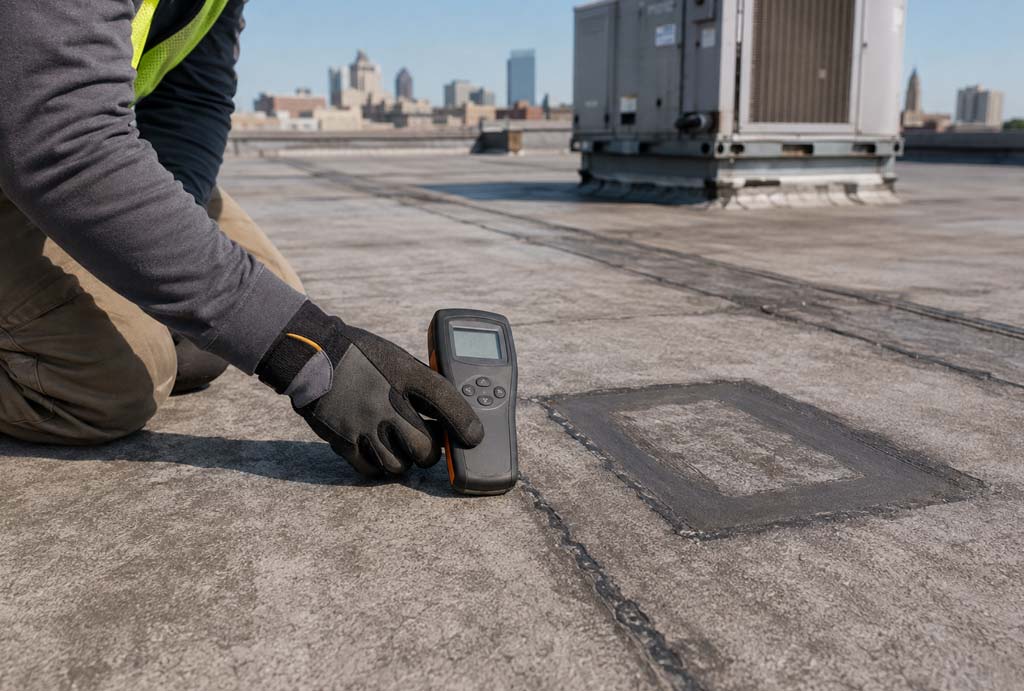
The coating-versus-replacement decision should begin with a thorough commercial roof inspection. The purpose is to determine what is happening both on the surface and, when necessary, within the roof assembly.
The evaluation may include:
- Overall membrane condition
- Open seams, punctures, and previous patches
- Flashing around walls and rooftop equipment
- Roof edges, coping, drains, gutters, and scuppers
- Ponding water and low areas
- Signs of wet insulation
- The condition of the roof deck
- The number of existing roofing layers
- Adhesion and coating compatibility
- Interior leak locations and moisture damage
Depending on the roof, additional testing may be recommended. Moisture scans, core samples, adhesion tests, or test cuts can provide information that is not visible during a surface inspection.
A good proposal should also explain the required preparation. If a coating estimate does not address repairs, cleaning, flashing details, wet insulation, application thickness, drainage, and warranty requirements, the owner may not be seeing the full scope of the project.
How Indianapolis Weather Affects the Choice
Commercial roofs in Indianapolis must handle summer heat, heavy thunderstorms, wind, hail, freezing temperatures, snow, ice, and repeated freeze-thaw cycles. These conditions can stress seams, flashing, fasteners, sealants, drains, and older membranes.
Coatings need proper surface preparation and suitable weather during installation. Temperature, humidity, roof moisture, and the chance of rain can affect curing and adhesion. Scheduling the work during an appropriate weather window is part of a successful project.
Replacement may involve more planning and a larger initial investment, but it also gives the owner an opportunity to correct drainage, replace saturated insulation, improve thermal performance, and install a system designed for the building’s current use.
The U.S. Department of Energy recommends considering climate, insulation, roof type, and heating and cooling demands when evaluating cool roofing products. Reflectivity can be beneficial, but it should be viewed as one part of the complete roofing decision.
Compare Total Value, Not Only Initial Cost
A coating generally has a lower upfront cost than a complete tear-off and replacement. That does not automatically make it the better financial choice.
Building owners should compare:
- Expected service life
- Required repairs before installation
- Warranty coverage and exclusions
- Future maintenance requirements
- Potential tenant or business disruption
- Energy and insulation needs
- Plans to keep, sell, or renovate the building
- The likelihood of needing replacement in the near future
If the existing roof is dry and stable, a coating may provide strong value by extending the current system. If the assembly contains widespread moisture or serious damage, investing in replacement may prevent repeated repair expenses and another major roofing project shortly afterward.
Get a Clear Commercial Roofing Plan
You do not need to decide between coating and replacement before contacting a roofing contractor. That decision should come after the roof has been inspected and the findings have been explained.
Stay Dry Roofing provides commercial roofing services for offices, warehouses, retail properties, multifamily communities, churches, industrial buildings, associations, and other properties throughout Indianapolis and Central Indiana.
We can evaluate the current roof, identify repairable areas, look for signs of trapped moisture, and explain whether repair, coating, partial replacement, or complete replacement offers the most practical next step. The goal is a solution that fits both the building and the owner’s long-term plans.