

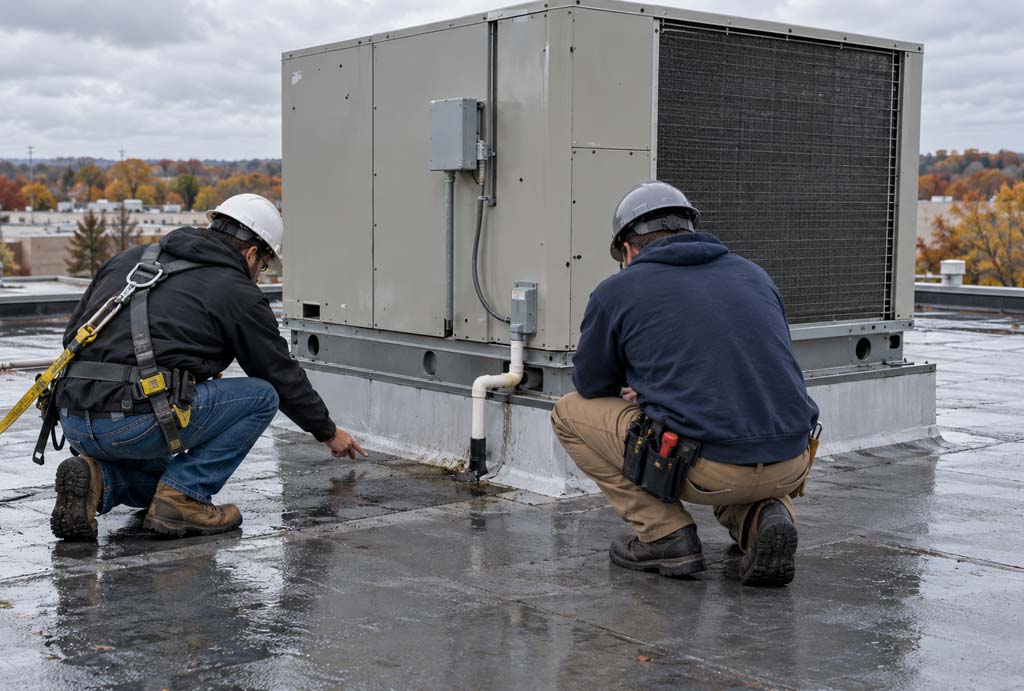
A ceiling tile below a rooftop HVAC unit develops a brown ring. The next rain makes it larger, and the property manager calls a roofer. That is a sensible start, but the unit’s location alone does not prove the roof membrane is leaking. Water may be entering at the curb flashing, traveling from another roof detail, or coming from the equipment itself.
A leak near rooftop HVAC needs two questions answered: When does the water appear, and where is it entering the building? Answering those questions before approving a patch can prevent repeat service calls and help the right trades work together.
Three places the water may begin
The roof-to-curb transition. Most packaged rooftop units sit on a raised curb. The roofing membrane turns up the curb and is finished with flashing and protective details. Open seams, deteriorated flashing, movement, or damage from later equipment work can create a path for rain. The Insurance Institute for Business & Home Safety includes the flashing between roof covering and roof-mounted equipment among the components to evaluate during a roof survey. See its roof survey guidance.
The surrounding roof. The membrane near the unit may have a puncture, seam problem, or recurring pool of water. The ceiling stain might be below the HVAC unit even though water entered several feet away and traveled along the deck or other concealed components. A roofer should look beyond the curb perimeter rather than assume the closest visible detail is the culprit.
The equipment. Cooling equipment produces condensate that should leave through its drain system. A blocked line, overflowing pan, loose connection, or other HVAC issue can wet the area around or beneath the unit. Trane describes condensate overflow protection for certain packaged rooftop units because a rising water level in the drain pan can create a flooding risk. The applicable equipment and diagnosis vary by model. See Trane’s rooftop-unit guidance.
The right repair depends on which of those paths is confirmed. A roofing patch does not clear an HVAC drain, and servicing a drain does not repair failed curb flashing.
Use the timing to narrow the search
Ask tenants or maintenance staff when they first noticed the water. Did it appear during or soon after rain? Does it recur on dry days while cooling equipment runs? Did the problem begin after an HVAC replacement or service visit? In late October, changing weather and operating schedules can make the pattern less obvious, so record actual dates rather than relying on a general impression.
Timing is a clue, not a verdict. Rain may reach an equipment opening; condensate may find a path through a poorly sealed curb; both issues may exist. A contractor should inspect and document the suspected entry path before assigning responsibility.
Keep a simple log of the affected room, ceiling location, weather, whether the unit was operating, and any nearby work. Photograph the stain with enough room context to identify it later. If water is near electrical equipment or disrupting occupied space, protect the area and arrange prompt professional attention.
What a useful inspection should cover
The roofer should identify the unit and roof section, then check the membrane, seams, curb base flashing, upper termination and counterflashing, adjacent penetrations, and drainage around the equipment. GAF explains that roof penetrations require correctly integrated flashing and that gaps around them can also create condensation concerns within the assembly. Read GAF’s guidance on low-slope roof penetrations.
An HVAC technician should examine the unit’s condensate pan, drain, discharge routing, and equipment connections when the evidence points that way. Neither trade should be expected to certify work outside its scope. For a persistent problem, a coordinated visit can be more efficient than two separate repairs based on guesses.
Ask for photographs tied to the unit number or roof plan, a description of what was observed, and a clear distinction between confirmed defects and suspected hidden conditions. Our guide to commercial roof inspection reports explains why location-specific documentation matters for future maintenance and approvals.
Match the repair to the finding
An isolated flashing defect may call for a compatible curb-flashing repair. A damaged membrane section or wet insulation may require a larger localized scope and further testing; our article on wet commercial roof insulation covers that decision. A condensate problem calls for HVAC service and a check that discharged water is not creating a new roof problem.
If the unit is due for replacement, coordinate the roofer and HVAC contractor before the equipment is lifted or reset. Changes to curbs, penetrations, or support locations can affect roofing details and warranty documentation. The goal is a watertight transition after the mechanical work is finished—not a patch applied to a detail that will soon be disturbed again.
Stay Dry Roofing can inspect the roof area around rooftop equipment and document the roofing conditions for Indianapolis building owners and managers. Request a commercial roof assessment if water is appearing below an HVAC unit, and share the unit’s service history so the investigation starts with the full picture.
Frequently asked questions
Does a ceiling stain directly under an HVAC unit mean the curb is leaking?
No. Water can travel within the roof assembly, and the equipment may also produce or leak condensate. The location is a starting point for investigation.
Should I call a roofer or an HVAC contractor first?
If the leak follows rain, begin with a commercial roofer. If it occurs on dry days while the unit runs, HVAC service is especially important. Share the full pattern; both trades may be needed.
Can a roofer just seal around the HVAC unit?
A surface bead of sealant may not correct a failed membrane-to-curb detail, and it will not fix an equipment drain. Have the entry path identified and specify a repair compatible with the roof system.
What records should a property manager keep?
Keep roof plans, unit identifiers, leak dates, weather notes, HVAC service records, roofing repair reports, photos, and warranty information together. They make recurring leaks easier to trace.