

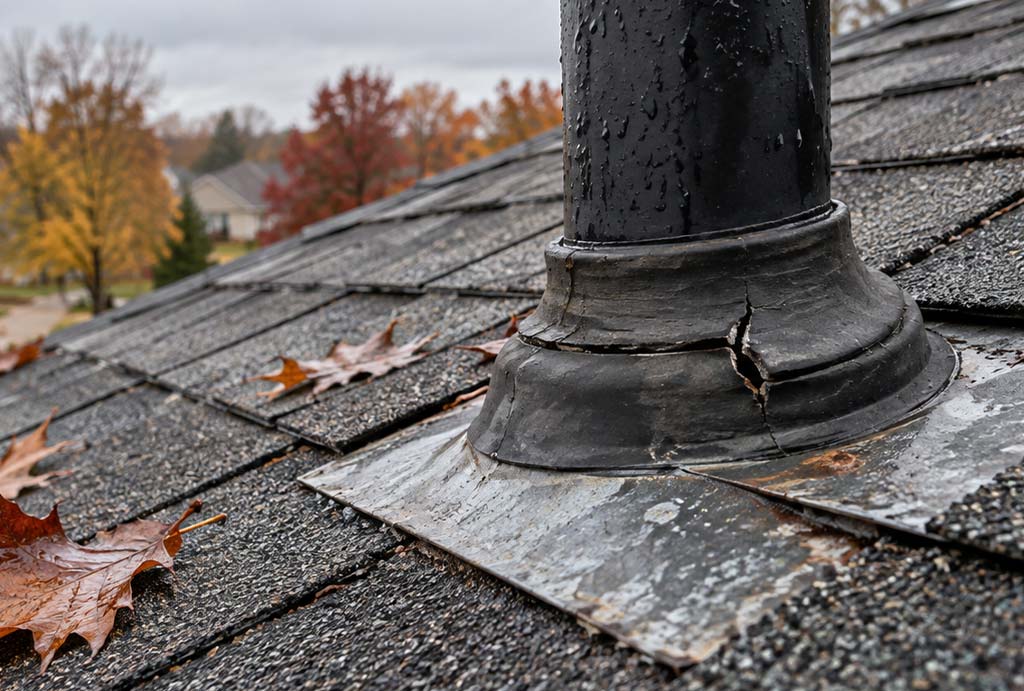
A small brown spot appears on the bathroom ceiling after rain. Looking up from the yard, you can see a pipe sticking through the roof roughly above that room. It is reasonable to suspect the pipe, but the ceiling spot alone cannot prove where the water entered.
One possible culprit is a failed pipe boot, the flashing that seals a plumbing vent where it passes through the shingles. The rubber collar can split or pull away, or the flashing base can be damaged or installed incorrectly. Rain then finds an opening beside the pipe. A roofer should confirm the entry point before replacing anything, because water can travel along the roof deck and show up some distance from the actual leak.
First, know which roof vent you are looking at
A plumbing vent is usually an open pipe extending above the roof. It lets the home’s plumbing drain system breathe; its pipe boot is built to shed rain around the outside of that penetration. A bathroom exhaust vent is a different component, often a capped housing connected to a fan duct. Its leak and moisture problems can involve the cap, its flashing, or the duct connection.
That distinction is useful when describing the problem to a contractor. A ceiling stain near a bathroom does not automatically mean the nearby roof pipe is the source. The roofer should identify each penetration above the area and check the attic, if accessible, before deciding what needs repair.
Signs that make a pipe boot worth checking
From the ground, you may not be able to see a narrow split in the rubber. You can note the pattern of the leak. Does a stain grow shortly after rain? Does the same area become damp during wind-driven storms? Is there a dark trail on the underside of the roof sheathing near a vent pipe in an accessible attic? Those clues are worth photographing and sharing.
On the roof, a professional may find a cracked or dried-out collar, a gap between the collar and pipe, bent metal flashing, loose fasteners, or shingles that no longer overlap the flashing correctly. GAF identifies damaged or incorrectly installed collars and flashing as common causes of plumbing vent pipe leaks. Read GAF’s guide to roof vent pipe leaks.
If water is actively dripping indoors, move belongings out of the affected area and arrange an inspection promptly. Do not climb onto a wet roof to examine the boot yourself.
Why a tube of caulk is rarely the whole repair
It is tempting to seal a visible crack and call the leak fixed. But the boot is part of a layered roof detail. Its base must shed water onto the shingles below while the shingles above overlap it. Sealant applied over an incorrectly lapped base can trap water or hide a gap without correcting the path rain takes beneath the roofing.
When the collar has failed but the surrounding roof is sound, replacing the pipe boot and restoring the adjacent shingle detail may be a focused repair. If the leak has continued for a long time, the roofer may also need to check the roof deck and insulation for moisture damage. A full roof replacement is not automatically necessary because one pipe boot fails.
Ask for photos of the damaged component and an explanation of what the repair includes. Will the old boot be removed? Are any nearby shingles damaged or too brittle to lift and reinstall? Does the proposed product fit the pipe diameter and roof slope? Our broader guide to flashing problems around vents, chimneys, and skylights explains how these details protect the roof.
What if the stain appears without rain?
Mid-October brings cooler nights in Indianapolis, so it is worth asking a second question: does the dampness correlate with rain, or with cold mornings and bathroom fan use? Warm, moist indoor air can condense on cold attic surfaces. A bathroom fan that exhausts into the attic rather than outside can add to that moisture. The U.S. Department of Energy’s Building America guidance explains how attic condensation can form on the underside of roof sheathing in cold weather. See its attic condensation guide.
This does not rule out a roof leak. Both problems can exist at once. It does mean a careful inspection should look for the direction of staining, the condition of the boot and surrounding shingles, and whether a fan duct is properly connected and vented outdoors. Treating condensation as a pipe-boot leak—or vice versa—can leave the actual source untouched.
A sensible next step for an Indianapolis homeowner
Write down when you first noticed the stain and whether it changes after rain. Photograph the ceiling and any safely visible attic staining. If you recently had plumbing, bathroom fan, or roofing work done, share that timeline with the roofer. The goal is to identify the water path, repair the failed detail, and check for damage it may have caused.
Stay Dry Roofing can inspect the vent penetration and nearby roof components, explain the findings, and recommend a targeted roof repair when appropriate. Schedule a roof inspection if a stain is growing or you suspect water is entering around a vent pipe.
Frequently asked questions
Can a pipe boot leak even if the shingles look fine?
Yes. The collar or flashing around a plumbing vent can deteriorate while the surrounding shingles remain serviceable.
Does a ceiling stain directly below a pipe prove the boot is leaking?
No. Water may travel along framing or sheathing before it appears inside. A roofer needs to trace the likely entry path and check nearby penetrations.
Can only the pipe boot be replaced?
Often, yes, if the rest of the roof and nearby shingles can be repaired properly. The scope depends on the flashing detail and any hidden water damage.
Is a bathroom exhaust vent the same as a plumbing vent pipe?
No. A plumbing vent serves the drain system; a bathroom exhaust vent carries humid air from a fan. They use different roof details and can create different moisture problems.